VibeVoice

VibeVoice
Stop typing.
Start speaking.

Speech to text for everywhere you type.
3x faster than your keyboard — emails, messages, documents, code.

Free tier: 30 minutes a month, no card.

SpaceHoldSpeakPaste

Automatically generated — may contain errors. Please review before use. What you say here is transcribed on our servers, and the transcript is kept for 30 days. Privacy policy.

Everywhere you type, not just here

Download the client

Press your shortcut, wherever you are typing

One key, the same everywhere — your editor, your mail client, a chat window, a web form. No per-application setup, no plugin per program, nothing to configure for the next app you install.

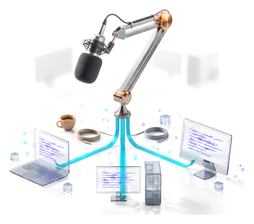
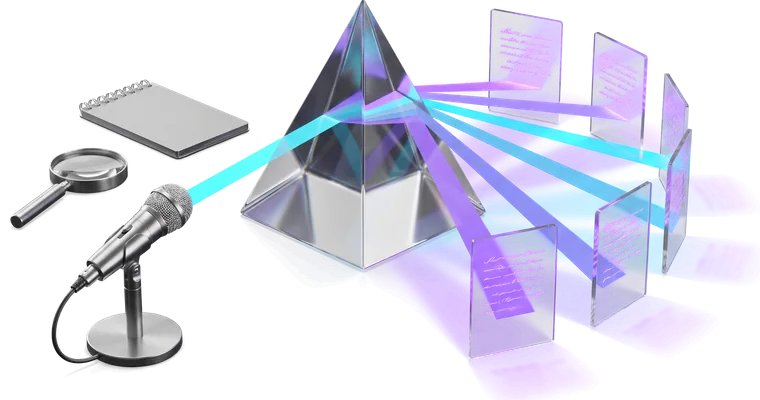
A glass prism taking one cyan ribbon from a steel desk microphone and separating it into six bands, each reaching its own upright glass card of text

Weighing us against something else?

€3 a month, a native client on Windows, macOS and Linux, and your text finished about half a second after you stop talking. Every comparison below prices the alternative in euros for a buyer in Germany, names its source, and says where the other product wins.

What it costs

Free

€0/month — For trying it out

  • 30 minutes per month
  • Web interface & file upload
  • Desktop client for Windows, macOS and Linux
  • Max 100MB files, 10 min duration

Pro

€3/month — For regular transcription

  • 180 minutes per month
  • Max 1GB files, 60 min duration
  • All Free features
  • Word-level timestamps for precision editing

Ultra

€10/month — For heavy usage

  • 6,000 minutes per month
  • Max 10GB files, unlimited duration
  • All Pro features
  • Speaker separation on file uploads (diarization)

All prices are final. No VAT is charged (small-business scheme, § 19 German VAT Act). Support is one address for every plan, paid or free.

What a minute counts as, and what happens when they run out

Common questions

A small client sits in your tray on Windows, macOS or Linux. Press the shortcut you chose and talk. Text starts arriving while you are still speaking, in pieces that close at your natural breaks — which is what lets it come back punctuated — and the last piece follows about half a second after your final word: a median of 481 ms, 95th percentile 522 ms, over 27 runs. It types into whichever window has focus, the way a keyboard does, so there is nothing to paste and nothing to configure per application. Your machine only captures and types; the transcription happens on our servers.

Yes — upload the recording and you get the transcript back. On Ultra it is split by speaker, so you can see who said what. We do not summarise: what you get is the words, and what you do with them afterwards is up to you.

A software developer who could no longer type through a working day — a nerve injury in his left hand, from years of it. He built this to keep working. That is also why the Linux client is not an afterthought and why the free tier exists: it started as a tool for one person who needed it.

About three times, on the usual averages: 40 to 70 words a minute typed against 120 to 160 spoken. Whether it holds for you depends on what you write and how much you correct — code and heavily punctuated text close the gap fast. There is a stopwatch on our speed page that measures your own two numbers rather than quoting ours.

Dictating a paragraph costs no keystrokes, and for anyone whose hands hurt that is the point — it is why this was built. We are not in a position to make medical claims: whether it helps your condition is a question for someone qualified to answer it. What we can say is what it changes, which is that the typing stops and you are no longer held at the keyboard.

Three things, and we have a page comparing us with each named alternative. Speed: text arrives while you are still talking, and the last piece lands about half a second after you stop — not minutes later, and not only once you finish. Reach: the client types into whatever has focus, so it needs no plugin per application. Platform: Windows, macOS and Linux are the same build with the same features, where two of the seven products we compare ships a Linux client at all.

It needs a connection. Transcription happens on our servers in Germany, which is what lets a five-year-old laptop be as fast as a new one and keeps your fans quiet. Your audio is deleted as soon as the transcript exists or the attempt fails, and is never used to train anything. If audio must never leave your machine, say so before you buy — a local tool is the right answer and we will point you at one.

Over fifty, detected on their own — there is no language to select and no setting to change, and you can switch between them from one dictation to the next. We publish word error rates for six of them, with the method used to get them.

Diarization splits an uploaded recording by voice and labels the parts Speaker 1, Speaker 2 and so on, so a meeting reads as a conversation rather than a block. It is on Ultra. Word-level timestamps give a start and end time for every word, which is what subtitle and video tools need to line text up with audio; they are on Pro and Ultra.